Introduction
If you've been working in IT long enough, you've probably seen it happen. A team spins up a few cloud resources — maybe an EC2 instance here, a storage bucket there — and six months later, the Finance team is waving a five-figure invoice and asking uncomfortable questions.
Public cloud is powerful. It's flexible, scalable, and genuinely transformative for modern IT infrastructure. But that same flexibility that makes it great is also exactly what makes it expensive when left unchecked. Workloads sprawl. Forgotten resources accumulate. Tagging conventions fall apart. Before you know it, you've got hundreds of line items in your cloud bill and nobody can explain half of them.
That's where FinOps comes in.
FinOps — short for Financial Operations — is a cultural and operational framework designed to bring financial accountability to the variable, on-demand world of cloud spending. In this post, we'll break down the FinOps Framework, explain how it applies specifically to public cloud environments, and walk through the best practices that help IT teams go from reactive cost panic to proactive cost control.
Quick note on timing: The FinOps Foundation released a major Framework 2025 update in March 2025, which introduced "Scopes" as a core element — and Public Cloud remains the primary Scope, since FinOps was born specifically to address cloud cost management challenges. So there's no better time to revisit the fundamentals. The FinOps Foundation
Core Concept: The FinOps Framework Explained
What Is FinOps?
The FinOps Framework is a set of practices, principles, and roles that show an organization how to manage cloud costs collaboratively across finance, business, and engineering teams. Think of it as a shared language and operating model — a way to get the developers, finance folks, and leadership all working from the same playbook when it comes to cloud spending decisions. Yuki
It replaces reactive cost reviews with ongoing collaboration, better forecasting, and more confident decision-making. It also gives organizations a structured approach to manage cloud costs by aligning engineering, finance, and product teams around a common goal — making informed decisions that balance cost, speed, and performance. ProsperOps
The Three Phases
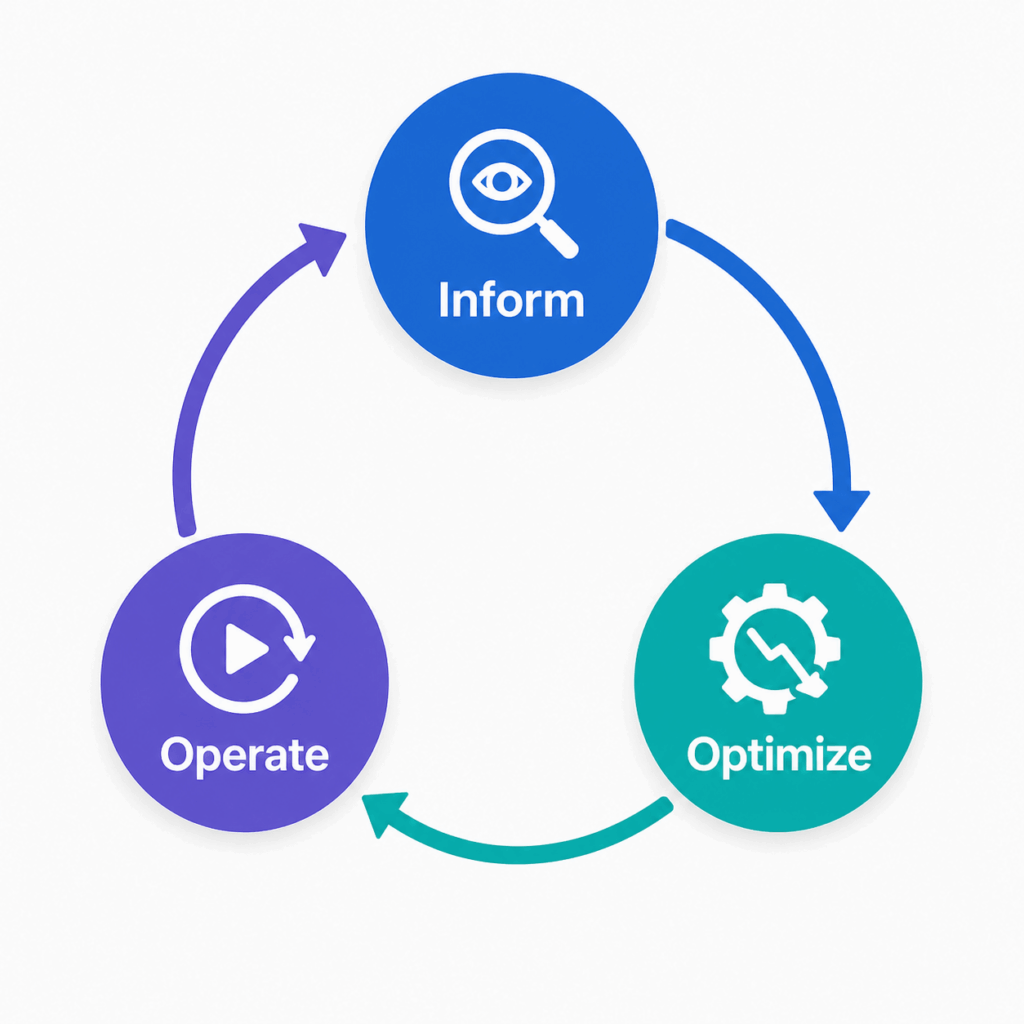
The FinOps lifecycle isn't a one-and-done project. It's an iterative loop made up of three interconnected phases:
🔍 Inform
The Inform phase is the foundational bedrock of any successful FinOps practice. You cannot control what you cannot see. The primary goal here is to provide accurate, timely, and granular visibility into cloud spending for all stakeholders. Quinnox
- For executives: understanding TCO and how spend maps to business units
- For engineers: seeing the cost impact of the services they deploy
⚙️ Optimize
Once you have visibility, you optimize. This is where right-sizing, reserved capacity purchases, and waste elimination happen. You're essentially asking: Are we using what we're paying for, and are we paying the right price for what we use?
🔄 Operate
This is about embedding cost accountability into day-to-day processes — automating governance, setting budgets, alerting on anomalies, and continuously improving. The FinOps framework is not a linear, one-time project. It is an iterative and continuous lifecycle designed to embed financial intelligence into every stage of your cloud journey. Quinnox
Key Personas: Who's in the Room?
FinOps works because it's cross-functional. The typical personas involved include:
- FinOps Practitioners — uphold efficient FinOps practices
- Finance — accurately budget and forecast cloud costs
- Procurement — source and purchase resources, manage vendor relationships
- Leadership — apply cloud strengths to maximize business value
- Security teams and Sustainability owners as allied personas Yuki
If your org has been treating cloud costs as purely a Finance or purely an Engineering problem, that's likely a root cause of overspending. FinOps makes it everyone's problem — in a good way.
FinOps Scopes (2025 Update): Public Cloud Is Still King
Scopes are a major new element in the 2025 framework. They allow organizations to segment their FinOps practice by specific areas of technology spend, ensuring teams can focus on the nuances of each domain instead of applying a one-size-fits-all approach. The defined Scopes include Public Cloud (AWS, Azure, GCP resources and infrastructure services), SaaS, Data Clouds (like Snowflake and Databricks), and Generative AI. Hyperglance
For most IT teams just getting started, Public Cloud is Scope #1 — and it's the most mature, well-supported area of FinOps practice. That's what we'll focus on here.
The Six Core Principles of FinOps
These principles are the philosophical backbone of the framework:
- Teams need to collaborate — Engineering, Finance, and Product must work together
- Decisions are driven by business value — Cost is not the only metric; it must be weighed against speed and quality
- Everyone takes ownership of their cloud usage — Decentralized accountability, not centralized gatekeeping
- FinOps reports should be accessible and timely — Real-time or near-real-time data, not monthly reports
- A centralized team drives FinOps — A dedicated FinOps function (even a small one) coordinates the practice
- Take advantage of the variable cost model — Cloud's flexibility is a feature, not just a cost risk
Best Practices for Public Cloud FinOps
Knowing the framework is one thing. Implementing it is another. Here are six high-impact practices to put into action.
1. 🏷️ Establish Tagging and Cost Allocation Early
Before you can do anything useful in FinOps, you need to know what you're spending money on and who is responsible for it. That starts with a consistent, enforced tagging strategy.
At a minimum, every cloud resource should be tagged with:
Environment: production | staging | dev
Team/Owner: platform-team | data-engineering | devops
Project/Application: payment-service | analytics-pipeline
Cost Center: CC-1042
No tags = no accountability. Build tagging enforcement into your IaC pipelines (Terraform, CloudFormation) from day one. Many organizations learn this lesson the hard way after months of untagged resource sprawl.
2. 📊 Enable Real-Time Cost Visibility Dashboards
Monthly billing reviews are a FinOps anti-pattern. By the time you see last month's bill, it's already too late to do anything about it.
Set up real-time cost visibility using native tools or third-party platforms:
| Cloud Provider | Native Tool |
|---|---|
| AWS | AWS Cost Explorer + Cost and Usage Reports (CUR) |
| Azure | Azure Cost Management + Billing |
| GCP | Cloud Billing Reports + BigQuery export |
Third-party options like CloudHealth, Apptio Cloudability, or Kubecost (for Kubernetes) can consolidate multi-cloud views and provide richer alerting.
The goal: your engineers should be able to check their team's cloud spend as easily as they check uptime metrics.
3. 🔧 Right-Size and Eliminate Waste
Cloud waste is shockingly common. Oversized instances, orphaned snapshots, idle load balancers, forgotten dev environments running 24/7 — they all add up.
According to Gartner, global public cloud expenditure is expected to surpass $723 billion by 2025 — and a significant chunk of that is pure waste. Industry estimates consistently put cloud waste at 30–35% of total spend. Quinnox
Right-sizing actions to take regularly:
- Compute: Downsize instances running at <20% average CPU/memory utilization
- Storage: Delete unattached EBS volumes, old AMIs, and orphaned snapshots
- Networking: Remove unused Elastic IPs, NAT Gateways with minimal traffic
- Databases: Identify RDS instances with zero connections
Schedule a monthly "waste hunt" review — it pays for itself quickly.
4. 💸 Use Commitment-Based Discounts
On-demand pricing is the most expensive way to run stable, predictable workloads. If your production environment has been running the same instance type for 6+ months, you're almost certainly overpaying.
Commitment-based discount options:
- AWS Reserved Instances / Savings Plans — up to 72% savings vs. on-demand
- Azure Reserved VM Instances — up to 72% savings
- GCP Committed Use Discounts — up to 70% savings
The FinOps approach: use on-demand for unpredictable/bursty workloads, reserved/committed pricing for your stable baseline. Even a 50% reservation coverage on your steady-state workloads can dramatically reduce spend.
5. 🤖 Automate Cost Governance Policies
Manual reviews don't scale. Build automated guardrails into your cloud environments:
- Budget alerts — trigger notifications at 80% and 100% of monthly budget
- Anomaly detection — AWS Cost Anomaly Detection, Azure Cost Alerts, GCP Budget Alerts
- Scheduler policies — auto-stop non-production resources outside of business hours
- Resource lifecycle policies — auto-delete unattached storage volumes after 7 days
Automation doesn't replace human judgment — it amplifies it by handling the repetitive stuff so your team can focus on strategic decisions.
6. 🧠 Build a FinOps Culture, Not Just a FinOps Tool
This is the one that organizations most often get wrong. FinOps isn't a product you install. It's a practice you cultivate.
FinOps practitioners have established strong financial accountability through collaboration across engineering, business, and finance, positioning them well to tackle cloud plus additional technology types. Finops
Practical culture-building steps:
- Hold monthly FinOps reviews with cross-functional stakeholders
- Publish internal "cloud spend leaderboards" (teams that optimize get recognized)
- Include cost efficiency in engineering OKRs and team goals
- Train engineers on the cost implications of architectural decisions — a NAT Gateway vs. a VPC endpoint isn't just a networking choice, it's a cost decision
The practice you have for governing public cloud spend should naturally include all new spend categories. It is simply another bucket of spend that requires the same discipline and governance. Finops
Final Thoughts
Cloud costs don't manage themselves — but with the right framework, they become manageable, predictable, and even optimizable without slowing down your teams.
The FinOps Framework gives you the language, the lifecycle, and the practices to bring financial intelligence into every cloud decision. Start with visibility (you can't fix what you can't see), build out your tagging and accountability structures, and gradually automate the governance layer.
You don't need to implement everything at once. In fact, the FinOps maturity model explicitly acknowledges a Crawl → Walk → Run progression. Pick the practices that will have the most immediate impact for your team — often that's tagging and real-time visibility — and build from there.
Cloud is a powerful lever for your business. FinOps makes sure that lever doesn't accidentally drain your budget in the process.