Fake Stores, Fake Reviews, Fake Delivery Notices
If your phishing training still tells people to look for typos, bad grammar and blurry logos, the last two weeks should worry you. On November 17, 2026, Malwarebytes published its annual holiday threat report and Visa published its Fall 2026 Biannual Threats Report — on the same day, from two very different vantage points, saying the same thing. AI hasn't invented a new category of fraud. It has stripped the seams off the old ones.
Malwarebytes puts numbers on the exposure: 77% of shoppers worry about being scammed by a retailer using a fake AI website or AI-misrepresented products and reviews, and 28% say they've already experienced an AI-related shopping scam in the past year. Visa, looking at payment-network data, found that travel and booking scams now use real reservation details to make fraudulent payment requests look completely routine.
This one's for whoever owns security awareness, fraud response, or identity controls at your org. The message for end users is short — don't click the delivery link, open the site yourself — but getting that to stick, and building controls that assume it won't always stick, is the harder part.
Two Reports, One Day
| Source | Published | What it measured | Headline |
|---|---|---|---|
| Malwarebytes holiday threat report | 17 Nov 2026 | Survey of 1,500 respondents across the US, UK, Germany, Austria and Switzerland (March 2026), plus scam telemetry from Nov 1, 2025–Oct 31, 2026 | 77% worried, 28% hit; Amazon and USPS top the impersonation lists |
| Visa Fall 2026 Biannual Threats Report | 17 Nov 2026 | Visa Payment Ecosystem Risk and Control analysis of threat activity, Jan–Jun 2026 | $1.4bn in potential fraud identified via Visa Scam Disruption (+40%); third-party incidents +62% |
These aren't the same kind of evidence, and it's worth keeping them separate in your head. Malwarebytes' percentages are self-reported worry and experience from a five-country survey run in March, paired with observed scam infrastructure from a twelve-month telemetry window. Visa's figures come from network-level fraud detection over six months. Treat them as two signals pointing the same direction, not one dataset.
Two wording cautions before these numbers end up in a slide deck. The 28% means respondents say they experienced an AI-related shopping scam — a misrepresented product, a fake storefront, a parcel that never showed up — not necessarily that they lost money. And 77% is concern, not incidence. Both distinctions are the first thing a skeptical stakeholder will push back on, so get ahead of it.
What the Data Actually Says
The rest of the Malwarebytes findings describe an environment where the usual trust signals have been quietly devalued:
- 85% agree that sophisticated scams can be hard to tell from the real thing, and 85% believe AI makes it easier for criminals to target people.
- 24% have received a scam message that felt highly personalized, sometimes using their name or other personal details. Among Gen Z, that rises to 32%.
- 42% of Gen Z say they've experienced an AI-related shopping scam, versus 30% of Millennials, 22% of Gen X, and just 9% of Boomers and older.
- 43% say it's acceptable for businesses to use AI-generated websites to sell products, and 60% say AI-enhanced product images are no different from regular advertising.
- Caution is up, but so is fatigue: 53% have avoided links in unexpected texts or emails because of AI, 36% have limited purchases from unfamiliar retailers, and 20% have used reverse image search on product photos. Still, only 41% are confident their current precautions would protect them, and 49% say they feel overwhelmed trying to keep up.
- 69% say they'd spend extra time or pay more for human customer service, and 43% have tried to reach a real person rather than an AI support system.
The age split is the finding most likely to get misread in a team meeting. It's tempting to conclude older staff are "safer." More plausibly, they're just less exposed to the marketplace and social-media channels where these lures thrive. Either way, the useful takeaway for an awareness program is that digital nativity is not immunity — your youngest, most online employees are the cohort reporting the highest hit rate, not the lowest.
Malwarebytes' Head of Consumer, Mark Beare, put the shift plainly:
"Scammers have a professional design team, a copywriter, a fake review section, and a nice package of data about you at their fingertips. The old giveaways like funky images, grammar mistakes, and off branding are gone."
That last line is the problem in a sentence. Every heuristic we spent a decade teaching people — check the spelling, look at the logo, does the photo look a bit off — was a proxy for effort. AI removed the effort.
Why the Old Playbook Broke
Three changes are doing most of the work here.
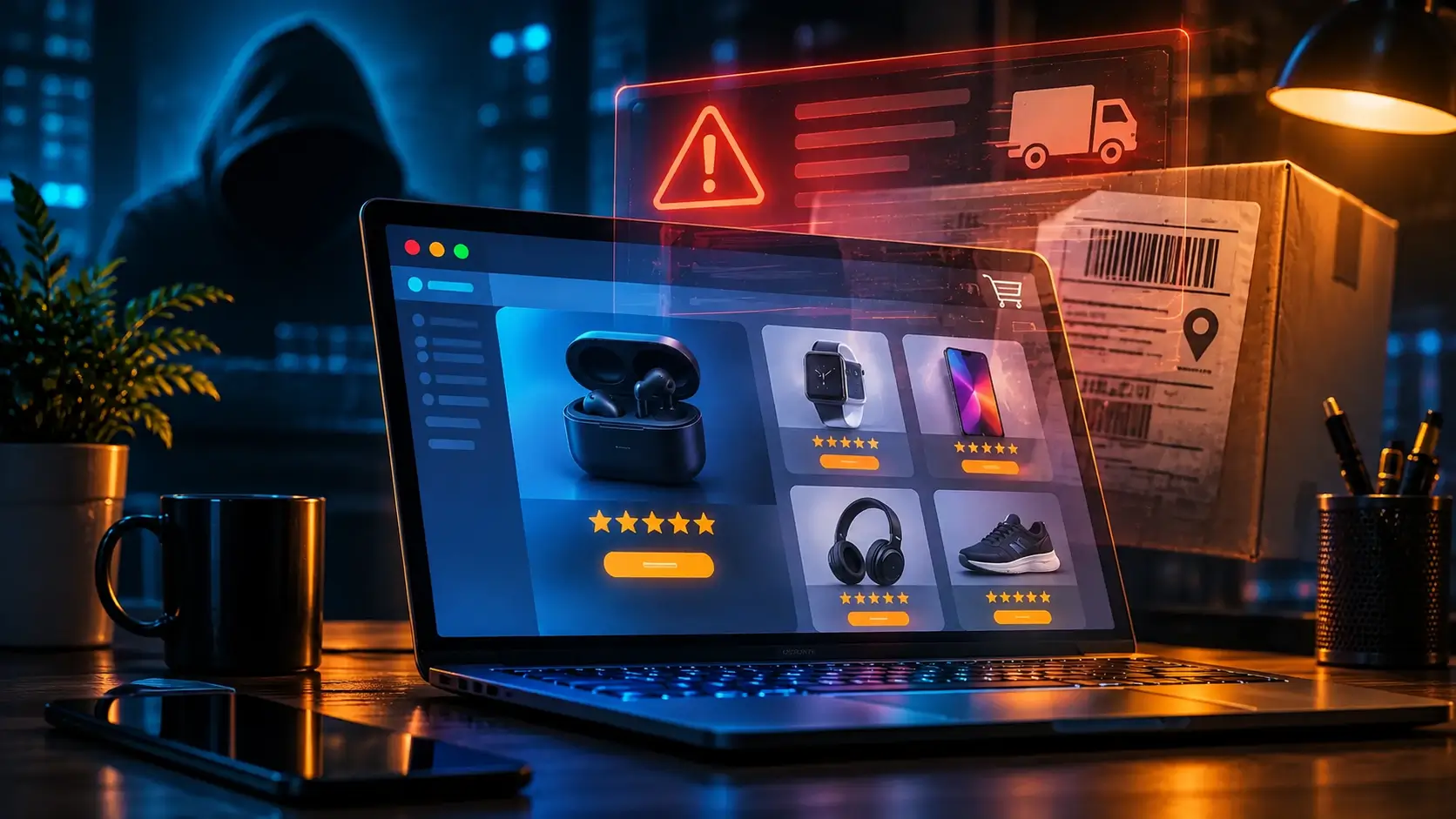
Fake storefronts got cheap and polished. A convincing retail site no longer needs a design team — just a prompt. Malwarebytes documented AI-generated products like cat-face flower seeds being sold online, extreme examples that were still persuasive enough to separate people from their money. The subtler versions — where the product is plausible and only the photos are enhanced — are a lot harder to reject on sight.
Social proof is manufactured end to end. Storefront, product imagery, testimonials, and "recently viewed" counters now arrive as one package. Because 60% of shoppers already accept AI-enhanced product images as normal advertising, a slick photo no longer triggers suspicion — and neither does a page full of five-star reviews.
The best lures now carry real data. This is where Visa's report matters most. Its travel and hospitality findings describe threat actors impersonating legitimate booking platforms and using real reservation details to convince consumers to authorize additional payments. Reporting from the Associated Press fills in the mechanism: scammers phish hotel staff, get into legitimate booking systems, then message travelers quoting their actual dates and the exact cost of their stay. As one scam expert told AP, "it's a real reservation that is weaponized against you."
Malwarebytes saw the same pattern closer to home, with a fake Facebook Marketplace listing tied to a person's real name and phone number. Visa's broader numbers explain where that data comes from: third-party incidents surged 62%, and its Scam Disruption work uncovered interconnected infrastructure spanning deceptive eCommerce, unauthorized recurring billing, and impersonation schemes. A breach at one vendor becomes the opening line of a scam message sent to a thousand victims.
Visa's own summary is the cleanest statement of the threat model:
"AI is not creating entirely new categories of fraud. Instead, it is helping criminals that execute existing attacks faster, at greater scale, and with greater precision, while increasingly targeting third-party providers that can provide access to multiple downstream organizations at once."
Lure → Control Mapping
The brands being impersonated are the ones people trust most in December. Malwarebytes' telemetry, collected between November 1, 2025 and October 31, 2026, puts Amazon, Walmart, Temu, Costco, and Steam at the top of the retailer list, and USPS, FedEx, DHL, UPS, and DPD at the top of the delivery list.
| Lure | Why it works | Control that actually helps |
|---|---|---|
| Delayed parcel, small "redelivery fee" via link | Realistic branding, urgent framing, a fee small enough to pay without thinking | Never pay from the message; open the carrier's own app. Enforce DMARC to stop exact-domain spoofing; monitor lookalike domains separately |
| Failed delivery, "confirm your address" | Plausible during a season of many parcels; harvests identity data, not just card data | One-click reporting; treat any personal data request in an unexpected message as a red flag |
| "Final notice" or 48-hour deadline | Compresses the time available for verification | Make "urgency = stop" an explicit part of training, not an inferred lesson |
| Real-looking retailer ad or storefront | AI-generated product photos and reviews survive casual inspection | Navigate directly to known retailers; card controls and virtual card numbers limit the blast radius |
| "Payment failed" on a genuine booking | Real dates and amounts defeat "does this look legitimate?" | Call the provider using a number from its official site; review third-party and vendor access |
| Personalized Marketplace message | Name and phone number create unearned familiarity | Data-footprint reduction; teach that personalization is a signal to verify, never proof of identity |
None of these controls is novel. What changed is the quality of the input. DMARC doesn't care how good the grammar is, but your staff do — and that gap is where the click happens. Worth noting: DMARC only stops exact-domain spoofing when enforced; the lookalike domains Malwarebytes flags in its delivery lures need monitoring and human judgment instead.
What to Actually Do
The one rule for staff
Never pay, reschedule, or "verify" from a link in a message. Open the app, type the domain, or call a number you find yourself.
That's the whole consumer-facing message. Urgency is the supporting tell: "final notice," a 48-hour window, a countdown on a deal. These are design choices meant to cut off verification, not information you actually need to act on.
Make the rule memorable and easy to follow. A one-click report button, a helpdesk that thanks people instead of making them feel dumb, and a feedback loop that feeds confirmed phish back into your filters will do more for you than another annual training module. In a lot of awareness programs, the first report arrives before the first click — that reporting-first loop is worth more than the training itself.
For defenders
- Refresh your simulation content. If your test messages still contain spelling mistakes, you're training people to detect the wrong signal. Use AI-quality copy, realistic storefronts, delivery notices, and reservation-hijack scenarios.
- Calibrate difficulty. Easy lures produce a lovely 2% click rate and teach nothing. Mix in hard, well-contextualized messages. The 42% Gen Z figure is a good reason to test the channels your younger staff actually use.
- Measure behavior, not completions. Track time-to-first-report and repeat-click rate. Drop completion-rate dashboards from the security report — they measure attendance, not resilience.
- Assume the click. Phishing-resistant MFA, enforced DMARC, session revocation, rapid credential reset, and card controls are the controls that still work when the rule fails.
- Fold third-party risk into the awareness story. The +62% figure and the hotel-system compromise route make vendor credential review part of consumer scam defense, not a separate procurement problem.
- Publish a one-page "I already clicked" path. Close the page, don't enter further details, reset the password from a clean device, revoke active sessions, contact the bank, report the message. No blame, no ticket queue drama.
A short pre-purchase checklist is worth putting in front of staff before the holiday rush really kicks off:
- Did I arrive here by typing the address or opening the app — not by clicking a link?
- Does the domain match the brand exactly, character for character?
- Am I being rushed?
- Have I checked the product, hotel, or seller on an independent site — or reverse-searched the photo?
- Would I be comfortable giving my card details over the phone, on a number I found myself?
Debrief
- The visual tells we trained people to spot are gone. The input quality changed, so your simulations and guidance need to change with it.
- The most convincing lures now carry real data harvested from breached third parties. Personalization is a reason to verify, not a reason to relax.
- The highest-value move remains the unglamorous one: a rule people actually remember, an effortless way to report, and technical controls built on the assumption that someone will click anyway.
Sources
- Malwarebytes — New Malwarebytes Research Reveals More than 1 in 4 Shoppers Have Been Hit by an AI-Related Shopping Scam, 17 Nov 2026
- Malwarebytes Labs — Holiday shopping in a world of fakes: How AI is changing the game, 17 Nov 2026
- Visa — Visa Report: AI-Enabled Fraud and Third-Party Attacks Are Scaling Worldwide, 17 Nov 2026
- Associated Press — Travel scams are getting harder to spot. Here's how to stay safe, 10 Sep 2026