For most of its 25-year life, VMware Workstation cost you real money — somewhere between $200 and $350 for a perpetual license, depending on when you bought in. Then, in November 2024, Broadcom gave it away. Not "free with a catch," not "free tier with upsells" — free for personal use, commercial use, and education alike, no license key required. The paid support line got switched off at the same time.
If you've been running homelabs and test environments as long as I have, that's a strange thing to watch happen. A product that anchored an entire company's desktop business for two and a half decades now costs nothing.
This post covers three things: how Workstation got here, why Broadcom actually did this, and — because "free" doesn't mean "the only option" — how it stacks up today against the two hypervisors most of us were already using instead: VirtualBox and the KVM/QEMU/libvirt stack that powers my own homelab.
A quick note on scope: this is a researched piece, built from release histories, vendor announcements, and community reporting, fact-checked against primary sources as of October 2026. It's not a benchmarking article — where performance claims get made, I've flagged them as general trends rather than hard numbers, because actual results depend heavily on your host kernel, your guest drivers, and whether Hyper-V is lurking in the background on a Windows host.
Part 1: The History
The first product (1998–2003)
VMware was founded in 1998, a Stanford spin-out built around a simple but genuinely disruptive idea: hardware virtualization could let one physical x86 machine safely host many isolated operating systems at once. Before this, an x86 server ran exactly one OS, full stop.
VMware Workstation 1.0 shipped on May 15, 1999 — the company's very first product, and the thing that made virtualization usable on an ordinary desktop PC rather than a lab bench. Early releases through version 3.0 (late 2001) nailed down the model we still use today: multiple full OSes running side by side, snapshots, shared folders. Workstation funded VMware before the server business even existed. GSX Server (2001) and ESX Server (2003) — the ancestors of vSphere — came later and eventually grew into the much bigger business.
Paid dominance (2004–2012)
EMC acquired VMware in a deal announced in December 2003 for about $635 million, closing in January 2004. VMware went public in 2007. Dell absorbed it when Dell acquired EMC in 2016, VMware was spun back out as an independent public company in 2021, and Broadcom finally bought it outright in 2023.
Through most of that stretch, Workstation was a straightforward paid product — roughly $200–$350 per perpetual license, plus a discounted upgrade path. It competed on polish: strong Windows guest support, 3D acceleration, snapshots and clones, and a clean path for moving a VM built on a laptop up onto VMware's server products.
Two things were quietly eating into that position the whole time:
- VirtualBox. Innotek released it in 2007 as open-source freeware. Sun bought Innotek in 2008; Oracle bought Sun in 2010. It ran on Windows, Linux, and macOS, and it cost nothing.
- KVM. The Kernel-based Virtual Machine merged into the Linux kernel in 2007. Paired with QEMU for device emulation, it gave Linux users near-native virtualization performance at zero cost — no separate hypervisor install required at all.
VMware itself also started handing out free tools during this period. VMware Server — a free, less capable rebrand of the GSX Server line — launched in beta in February 2006 and reached general availability that July. VMware Player, a free tool that could run existing VMs but not create new ones, was announced in October 2005 and reached the public by the end of that year.
The freemium squeeze (2012–2023)
The free tier kept creeping upward. Player eventually gained the ability to create VMs, which chipped directly at Workstation's core value proposition. In 2015, Workstation 12 merged the two product lines: a free Workstation Player for personal use, and a paid Workstation Pro for commercial users with the full feature set.
By the late 2010s, Workstation Pro was mature software competing in a market that had been free everywhere else for over a decade. Hyper-V ships with Windows. VirtualBox is open source. KVM is in every Linux kernel. VMware's actual money was in vSphere — and, after Broadcom took over, increasingly in VMware Cloud Foundation.
The Broadcom acquisition and the giveaway (2023–2024)
Broadcom completed its $61 billion acquisition of VMware on November 22, 2023, and started dismantling the old product catalog almost immediately. Perpetual licenses were retired in favor of subscriptions, a long list of standalone products (NSX, HCX, vSphere+, and others) got folded into two bundles — VMware Cloud Foundation (VCF) and VMware vSphere Foundation (VVF) — partner programs were cut, and customers started reporting price increases in the range of several hundred percent.
The desktop hypervisor line simply didn't fit the new strategy. Workstation and Fusion were small, individually-sold products with their own QA cycles and their own support queues — overhead that made no sense next to VCF's enterprise contracts. Two changes followed, six months apart:
- May 14, 2024 — free for personal use. Workstation Pro 17.5.2 and Fusion Pro 13.5.2 became free for personal use, no license key required. Workstation Player was discontinued as redundant now that Pro itself was free.
- November 11, 2024 — free for everyone. Broadcom confirmed that Workstation Pro and Fusion Pro are free for commercial, educational, and personal use alike. Paid subscriptions for the desktop hypervisors were discontinued entirely, and so was paid technical support — from here on, help comes from documentation and the community forum only.
Both dates matter. Inside six months, a paid product with a quarter-century price tag turned into freeware with zero paid support option.
Part 2: Why Give It Away?
Broadcom never published a detailed rationale beyond framing it as community investment. Reading the surrounding business moves, four explanations hold up.
1. It was a cost center, not a growth line
Broadcom's VMware strategy runs on a small number of high-margin bundles, VCF above all. Workstation was a SKU sold one license at a time — its own release cycle, its own QA, its own support queue, and revenue that was statistical noise next to a single VCF enterprise contract. Making it free removes the sales and licensing overhead while Broadcom keeps absorbing the (much smaller) engineering cost of maintaining it.
2. Paid support was the expensive part
The May 2024 change kept a licensing structure in place; the November 2024 change is what actually removed paid support. Support is where desktop software quietly loses money — tickets about Windows host updates, flaky GPU drivers, and Hyper-V conflicts are labor-intensive to resolve one at a time. Swapping that for forum-and-documentation support turns an open-ended cost into a fixed one.
3. It funnels people into the VMware ecosystem
Plenty of IT engineers use Workstation to build VMs that later get promoted to vSphere. A free Workstation keeps that workflow — virtual hardware versions, OVF exports, VMware Tools — inside VMware's world instead of pushing people toward VirtualBox or KVM. It's also a bit of goodwill at a moment when VMware's license price hikes were visibly pushing enterprise customers toward Proxmox, Nutanix, and hypervisor exit plans.
4. The competitive floor had already moved
Capable free hypervisors have existed on every platform since 2007. Charging $300 for Workstation only made sense while it had capabilities nobody else matched — best-in-class Windows guest support, 3D acceleration, tight integration with the rest of VMware's stack. By 2024, those advantages no longer justified a price tag to enough buyers. Giving it away turns the product's users into an asset instead of a shrinking revenue line.
The trade-off is real, and it got raised on Broadcom's own forums almost immediately: no license key means no formal entitlement document, which is awkward for anyone who has to answer to a corporate software audit. Free, in this case, means free with community support — not free with a contract.
Part 3: Workstation Pro vs. VirtualBox vs. KVM + QEMU + libvirt
These three overlap in function but not at all in design philosophy. Workstation Pro is polished commercial software that happens to be free now. VirtualBox is open-source software Oracle maintains as a general-purpose tool. KVM + QEMU + libvirt is a set of Linux kernel and userland components you assemble yourself — which, if you've spent any time with virt-manager and libvirt XML like I have, is either a feature or a chore depending on your mood that day.
| Dimension | VMware Workstation Pro | Oracle VirtualBox | KVM + QEMU + libvirt |
|---|---|---|---|
| Cost | Free (since Nov 2024) | Free (base package) | Free |
| License | Proprietary, closed source | Open source base (GPL); Extension Pack is proprietary, free for personal/educational use, paid for commercial use | GPL / LGPL (kernel, QEMU, libvirt) |
| Host OS | Windows, Linux | Windows, Linux, macOS (Intel, and Apple Silicon as of VirtualBox 7.2 — newer and less mature than the Intel path) | Linux only |
| GUI | Polished, feature-complete | Simplest of the three | virt-manager, Cockpit, or plain CLI |
| Performance | Strong; good I/O and 3D (SVGA) | Weakest of the three, especially 3D and multi-core | Near-native; best CPU, memory, and I/O ceiling |
| Snapshots / clones | Full support | Snapshots yes, cloning manual | Full support via libvirt and qcow2 |
| Encryption | Yes | AES-XTS disk encryption, but it requires the Extension Pack (free for personal/educational use; commercial use needs an Oracle Enterprise license) | Full support via libvirt and qcow2 |
| Automation | vmrun, VIX, PowerCLI-adjacent tooling | VBoxManage CLI | virsh, libvirt API, XML definitions — the deepest of the three |
| GPU passthrough | Limited (vGPU on supported NVIDIA cards) | Experimental | Best available (VFIO) |
| Learning curve | Low | Lowest | Steep: XML configs, bridges, UEFI, driver setup |
| Ecosystem | Migration path to vSphere, OVF, VMware Tools | Broadest legacy guest-OS support | Powers Proxmox, OpenStack, and most private clouds |
| Support | Documentation + community forum | Mailing lists, forums, Oracle bug tracker | Community + commercial (Proxmox, Red Hat) |
VMware Workstation Pro: the free premium option
This is the best choice when the host is Windows and the guests are Windows. Guest integration — clipboard, shared folders, 3D acceleration — is the most mature of the three, and since version 17.5 it can coexist with Hyper-V, though performance takes a hit when Hyper-V's virtualization-based security is turned on. The catch is structural, not technical: closed source, no paid support, and a license terms document from a vendor that has rewritten its commercial terms twice in one year. If Broadcom ever reverses course, migrating out means exporting and moving every VM you have.
VirtualBox: the low-friction option
Best choice for someone who wants a VM running in ten minutes on almost any desktop — Windows, Linux, or now macOS on both Intel and Apple Silicon. It handles the widest range of legacy guest operating systems of the three. The costs show up later: noticeably slower disk and graphics performance, and several independent comparisons report demanding 3D benchmarks simply refusing to run. It's Oracle-owned open source, so the code is there to fork if you ever need to, but the roadmap depends on Oracle's continued interest.
KVM + QEMU + libvirt: the ownership option
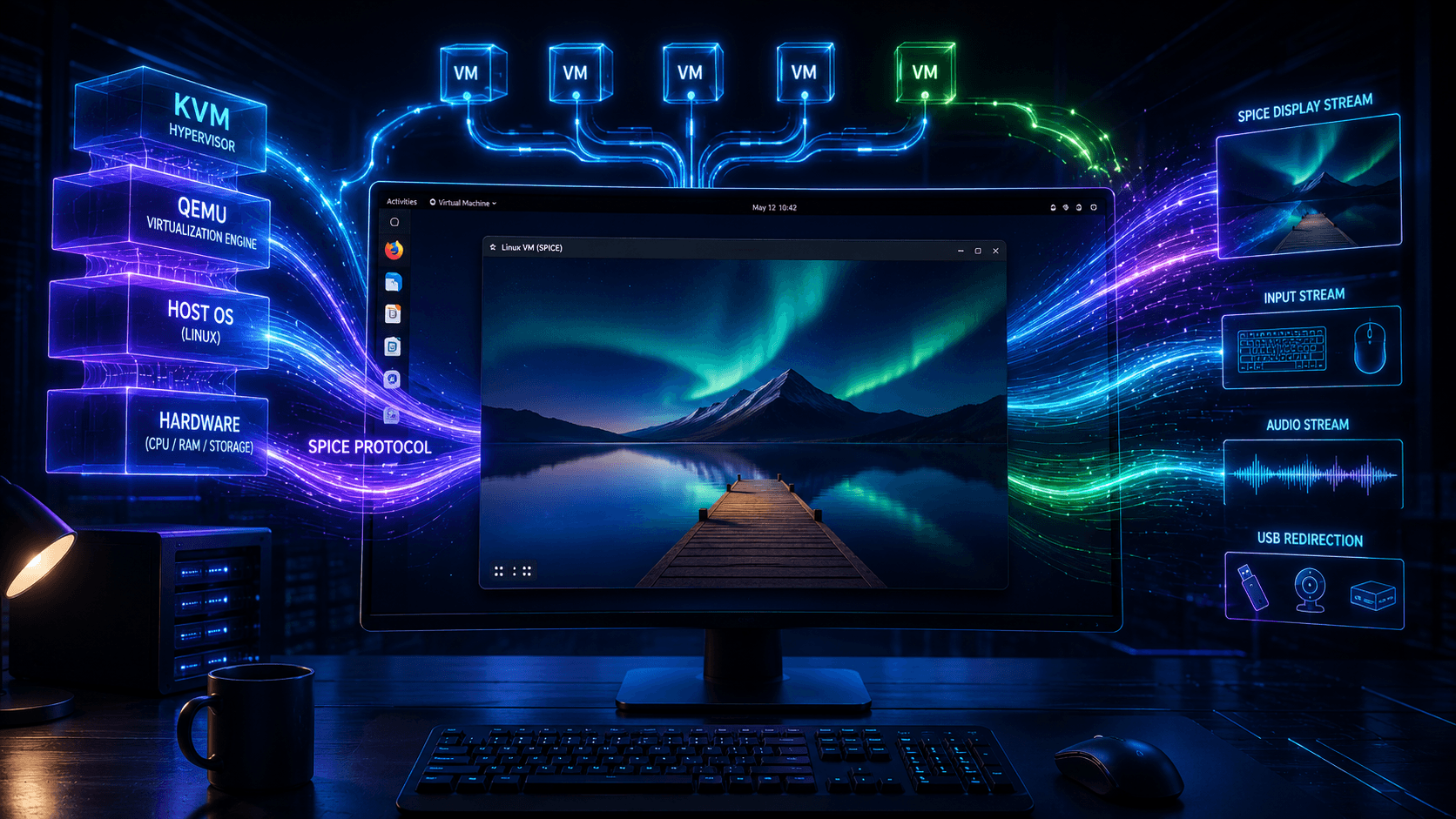
Best choice on a Linux host when performance, automation, or long-term control actually matters to you. KVM handles CPU virtualization in the kernel, QEMU emulates devices, and libvirt provides the management API that virt-manager, Cockpit, and Proxmox all sit on top of. It matches or beats Workstation on raw performance and is the only one of the three with real VFIO GPU passthrough — which is the whole reason I run a KVM-based compartmentalized desktop setup instead of reaching for a GUI hypervisor. The price is setup time: learning libvirt XML, configuring bridges, installing virtio drivers, and debugging your own mistakes. Nothing about it is graphical by default, and it won't hold your hand.
A note on performance claims circulating in 2026: benchmarks generally show Workstation leading VirtualBox by wide margins on I/O and 3D workloads, with KVM/QEMU matching or beating Workstation on CPU-bound tasks. Treat specific multipliers you see online with some skepticism — results swing heavily based on host kernel version, guest driver quality, and whether Hyper-V is active on a Windows host.
Choosing between them
- Host is Windows, guests are Windows or mixed, you want polish → Workstation Pro.
- First-time user, need a macOS host, or testing a pile of legacy OSes → VirtualBox.
- Host is Linux, and performance, automation, or GPU passthrough actually matters → KVM + QEMU + libvirt.
The Takeaway
VMware Workstation's 25-year arc — commercial pioneer, paid market leader, freemium squeeze, outright giveaway — tracks the commoditization of desktop virtualization pretty cleanly. Once Hyper-V, VirtualBox, and KVM made hypervisors free, it was only ever a question of when the last paid desktop option would follow. Broadcom answered in November 2024, for reasons that are pretty legible once you look at the rest of its playbook: cut support costs, keep users inside the ecosystem, and put sales effort behind VCF instead.
For users, free Workstation is a genuine windfall — it's still the most polished way to run Windows VMs on a Windows host, full stop. But "free as in no money" from a vendor that retired perpetual licenses, raised enterprise prices sharply, and cut paid support in the same eighteen months is a useful reminder: the tool you rely on is only as stable as the business model sitting underneath it. VirtualBox and the KVM stack can't be re-licensed out from under you. That's a real, durable advantage — not just an ideological one.
Sources
- VMware Workstation — Wikipedia (release history, 2024 licensing changes)
- VMware Workstation Pro 17.5.2 Release Notes — docs.vmware.com
- "VMware Fusion and Workstation are Now Free for All Users" — VMware VCF Blog, November 11, 2024
- Broadcom Completes Acquisition of VMware — Broadcom press release, November 22, 2023
- EMC Corporation SEC filings (10-Q/10-K, FY2004–2006) — VMware acquisition purchase price
- "History 2004: EMC Completed Acquisition of Privately-Held Software Company VMware" — StorageNewsletter
- VMware Workstation Player — Wikipedia (Player history, 2005 launch)
- "VMware Introduces Free VMware Server" — VMware press release, February 6, 2006
- VirtualBox — Wikipedia (Innotek/Sun/Oracle history, PUEL licensing)
- Oracle VirtualBox 7.2 release coverage — ARM host virtualization and Apple Silicon 3D acceleration
- Oracle VM VirtualBox documentation — Disk Image Encryption and Extension Pack licensing